Supercharge conversions with the Diamond Funnel Strategy
Welcome to a blog on mastering Facebook advertising in 2023! Facebook is one of the largest and most popular social media platforms in the world, making it an ideal place to advertise your business or product. However, with so many businesses advertising on the platform, it can be challenging to make your ads stand out.
In this blog, I will be sharing the latest tips, strategies, and best practices for creating effective Facebook ads in 2023. From understanding your audience to using the latest features, I will cover everything you need to know to make your Facebook advertising campaigns a success.
We’ll also be taking into account the latest changes and trends in the social media advertising landscape such as the rise of privacy concerns, data regulations and how to use first-party data to increase the effectiveness of your ads. Whether you’re a small business owner or a marketing professional, this blog will provide you with the information and tools you need to take your Facebook advertising to the next level in 2023.
The rise of privacy policies
The rise of privacy concerns and changes in data regulations, such as General Data Protection Regulation (GDPR) and California Consumer Privacy Act (CCPA), have had a significant impact on social media advertising. These regulations place restrictions on how companies can collect, use, and share personal data, which affects the way that social media advertising is done.
One of the main ways that these regulations have affected social media advertising is by limiting the amount of data that companies can collect and use for targeting ads. This means that companies may have a harder time reaching their target audience and will have to rely more on contextual advertising, which is based on the content of the webpage or app rather than personal data. These regulations also affect the way that companies will be able to track and measure the performance of their ads, as data collection will be limited. Therefore, it will be more difficult to track conversions and other metrics that businesses use to measure the effectiveness of their ads.
Overall, the rise of privacy concerns and data regulation will require companies to change the way they collect and use data for advertising, which may affect the effectiveness of their social media advertising campaigns.
Utilise first-party data as much as possible!
First-party data refers to data that is collected directly from the Facebook platform, such as video views, page likes, post comments etc. Third-party data, on the other hand, refers to data that is collected from other sources outside of the platforms. These are actions tracked by the FB pixel when people are not using the app itself. Once an individual clicks through a Facebook ad and lands onto a website, that data is then referred to as third party.
Using first-party data over third-party data can benefit social media advertisers in several ways:
- Better targeting: First-party data is data that is collected directly from the individual, such as through an email signup or purchase. This data is typically more accurate and up-to-date than third-party data, which is collected from other sources. Using first-party data can help advertisers create more targeted and effective campaigns by reaching the right audience at the right time.
- Compliance with data regulations: Using first-party data can help advertisers comply with data regulations such as GDPR and CCPA. These regulations place restrictions on the use of third-party data and require companies to be more transparent about their data collection practices. Using first-party data can help companies stay compliant with these regulations.
- Better measurement of results: With first-party data, advertisers can better measure the performance of their campaigns, since the data is more accurate and up-to-date. This allows for more accurate measurement of conversions and other metrics that are used to determine the effectiveness of the ads.
It’s worth noting that, first-party data can be limited in volume, specially for small and medium businesses, and therefore third-party data can still be used to complement the first-party data, but always with the proper permissions and consent of the user.
The Diamond Funnel
The paid social diamond funnel is a marketing strategy used to increase customer acquisition and revenue through social media advertising. The diamond funnel approach allows advertisers to reach the target audience at each stage of the funnel whilst keeping the cost per acquisition low and the campaign as profitable as possible. By leveraging different ad formats and targeting strategies, advertisers can create a more effective and efficient social media advertising campaign that generates more leads, conversions and retain customers.
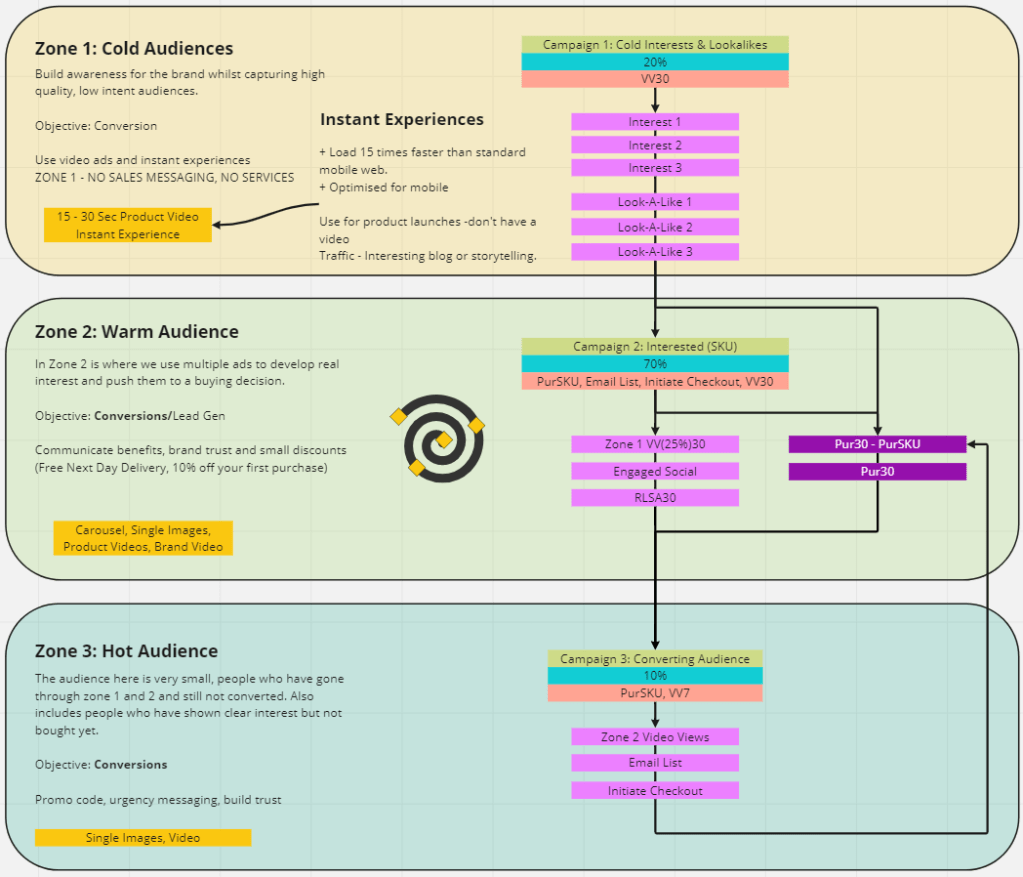
The diamond funnel is made up of four stages:
- Zone 1 (Awareness): The first stage of the diamond funnel is awareness, where the goal is to reach a large audience and generate interest in your product or service. This can be done by using ads that focus on building brand awareness and promoting your product or service.
- ONLY use videos: This will allow you to retarget the induvial who have watched more than 75% of the video (high quality audience + first party data). Retargeting individuals who have clocked through to your site may be slightly higher quality but will be much more expensive and less accurate (third party data).
- Use conversion a based objective – you want to make sure you focus on quality over quantity.
- Do not use any sales messaging in your ads – you want to capture people interested in your brand and product not a sale or discount.
- Zone 2 (Consideration): The next stage is consideration, where the goal is to convert interested individuals into leads. This can be done by using ads that focus on educating the audience about your product or service, and providing them with incentive to help them make a decision.
- Communicate benefits: Free next da delivery, 10% off first purchase etc.
- Use as many different ad creatives to nurture and convert the audience.
- Zone 3 (Conversion): The third stage is conversion, where the goal is to convert leads into customers. This can be done by using ads that focus on driving sales and promoting special offers or discounts.
- Use urgency messaging to get these final purchases
- Zone 2 (Retention): The final stage is retention, where the goal is to retain customers and increase lifetime value. This can be done by using ads that focus on providing excellent customer service and promoting loyalty programs.
Key Takeaways
- Use Video formatted ads where possible: Cheaper to run in 2023 and gives you the ability to retarget those who have watched past a certain amount.
- Always use conversion based objectives: Higher quality audiences will lead to more sales overall giving better campaign performance.
I hope you find this blog informative and useful, and I look forward to sharing my knowledge and insights on Facebook advertising with you!