Expand your reach with Dynamic Search Ads
What are Dynamic Search Ads?
Dynamic Search Ads use content from your website to target ads to customer searches. When customers search for terms that are closely related to your website content but are not included in exact match keywords campaigns, your website will be crawled to match the customers’ query.
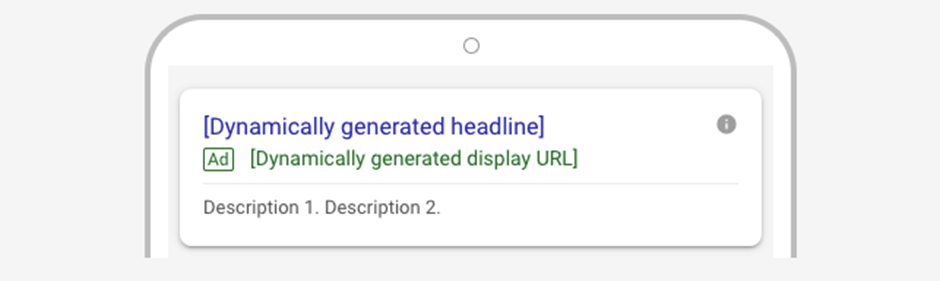
Dynamic Search Ads then automatically generate ad headlines that direct customers to the relevant landing pages. You have the option to customize the two description lines and ad extensions.
Benefits
- Biggest benefit – fills in any gaps that keyword choices leave behind. As Google crawls through all landing pages, it can identify keywords that have ben overlooked, helping bring new traffic and leads to your website.
- Developing new markets – Using DSAs can capture a larger spectrum of new keywords. Especially good for EU markets: Broaden spectrum where phrases can be said in multiple ways. Additionally, it removes the need to manually translate keywords as it pulls data straight from your landing pages.
- DSAs are useful for businesses that see a lot of changes in inventory and sites that sell seasonal products. You no longer need to update the product lists/ ad groups manually. DSAs will simply pull the appropriate phrases for them.
- For example, if you sell multiple fans under a fan product category page, creating ad groups for each one would be time consuming. With DSAs you can group the product types together and serve specific ads with dynamic headlines and URLs into a few ad groups.
- Remarketing campaigns – setting DSA campaigns with a returning customer audience. When a returning customer searches for your brand/brand product DSA will generate a more accurate headline to the user’s query, increasing the chances of them clicking through the ad.
- Google ADS Study in 2016 on Trivago showed a 140% increase in CTR on search terms for DSA vs original ads and significantly lower CPAs.
- A more recent case study (2021) showed similar findings. This case study looked at 100 accounts over a period of 2 months. When comparing normal DSAs against RL-DSAs, it was found that RLDSA campaigns had a 109% higher CTR at a 75% lower CPA.
- https://www.wordstream.com/blog/ws/2016/08/04/remarketing-for-dynamic-search-ads
- It’s good for long-tail keywords – DSAs can show up for keywords with a low search volume. DSAs can help catch searches that can not be targeted by standard search campaigns due to character limits.
Keyword Planner
Keyword planner can be used to scan a specific page to see the most relevant search terms google would target ads to. This can be used to negative out any keywords that you don’t want to bring traffic to – another benefit.
Cons
- Less control over the ad since the headline and landing page URL is generated by Google – only have the option to customize the description.
- Don’t have control over how the budget is spent on keywords. If the campaign is given a small budget it could end up using it all on one search term before being able to use it on a more profitable one. It comes back to have little control over the campaign and what it targets.
- Very reliant on landing pages having good SEO. Only checks through content (not photos/graphics and logos).
- Less of a con but something that must be implemented properly – a comprehensive negative keyword list to exclude search queries that bring irrelevant traffic. Also exclude keywords used in standard search campaigns so they’re not competing with one another. Excluding page content with phrases such as “out of stock” so they’re not targeted.
Types of Campaigns
There are a few ways about making these DSA campaigns:
- If you were to create one to increase conversions with returning customers then we should look at those campaigns that attract the most returning users. This shows that the specific product has search intent and needs a push that DSA can provide with its dynamically generating headlines; capturing users to convert.
- As DSA’s are dependant on the landing pages themselves, have a look at campaigns with high conversion rates: These pages are more likely to have the right SEO and keywords as they are converting well, hence DSA targeting would be more efficient in bringing new traffic to the page.
- Small campaigns for products that aren’t focused on too much. Rather than looking at campaigns you already have a lot of the keywords for, look at campaigns that aren’t as robust in this area. Test to see what keywords are missing and should be included in search campaigns.
- Looking at the Keyword planner for SUP board for example – there are so many variations for the name of the product. A DSA campaign would be good in determining which search term may have overlooked and should put more focus on.
- In a German market tent campaign – found that most impressions came for “strandmuschel” meaning ‘beach shell’ and not ‘zelt’ which means tent. This is a good indication of why DSAs would be good in broadening keyword choices for EU markets.
Targeting the campaign
When it comes to targeting the DSA ad groups there are a few ways of doing it; by google category (google crawls our site and suggests categories to split the site by) or specific URLs we can include/exclude.
- Creating an ad group targeting specific web pages. For example if you’re creating a DSA campaign targeting URL’s containing ‘____.com/products/fans’ it would crawl all fan product pages and generate headlines using them for relevant queries.



 Thana Tharun